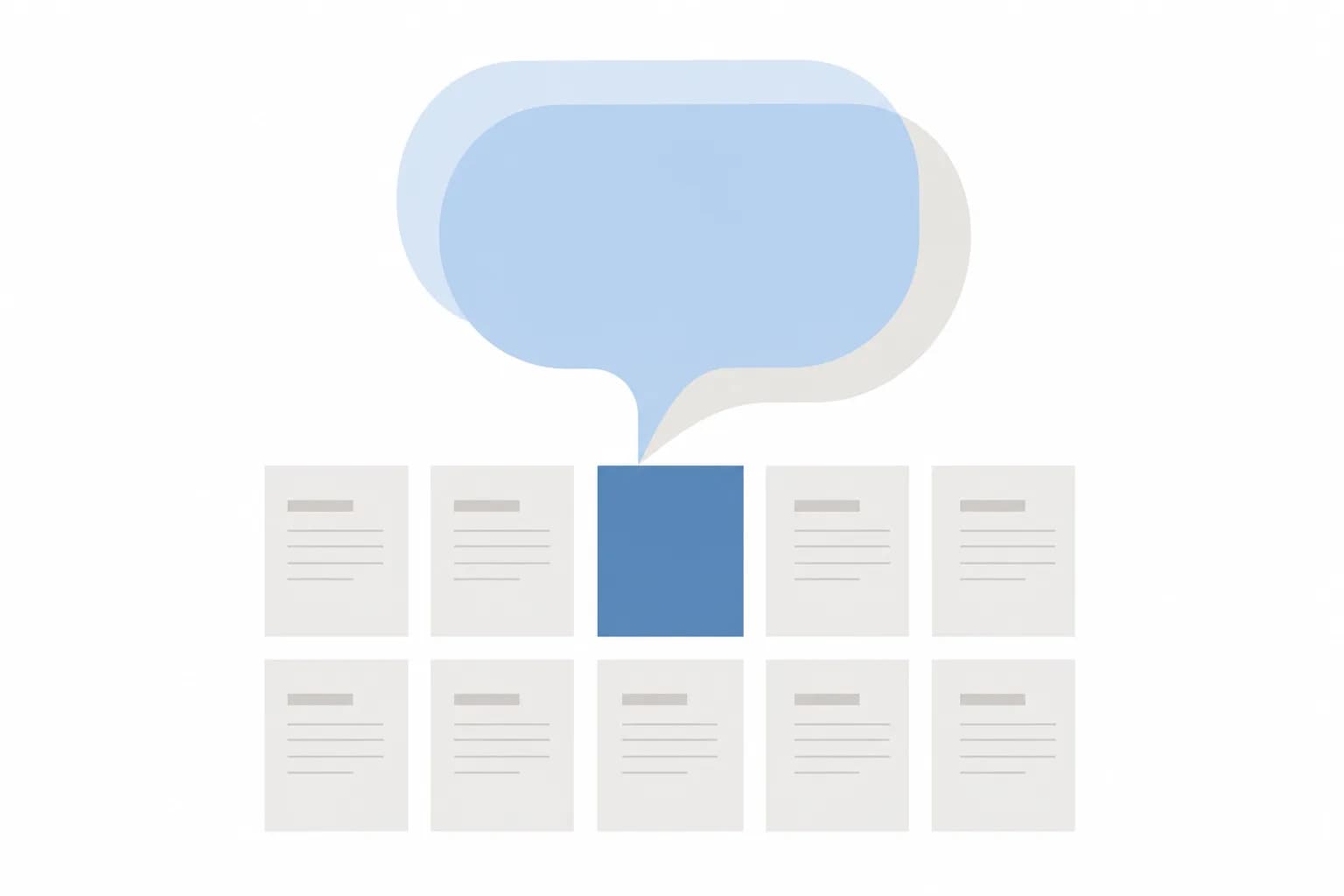

Artificial intelligence is a broad term for systems that perform tasks associated with abilities such as recognizing patterns, working with language or making predictions. In a business brief, the label alone says little about suitability. Describe the task, the information available and how the result will be checked.
How does AI differ from ordinary automation?
Ordinary automation can follow explicit rules: move a submitted form into a database or notify a team when a field changes. AI may help when the input requires interpretation, such as classifying a free-text request. Many workflows use both.
What is machine learning?
Machine learning refers to methods that learn patterns from data rather than relying only on manually written rules. A learned pattern can be useful for a defined task, but its output still needs evaluation against the data and conditions in which it will be used.
What is generative AI?
Generative AI produces content such as text or images in response to inputs. A language model can prepare a draft or summary, but generation does not guarantee factual accuracy. Approved context and review are essential parts of a practical brief.
Do you need an AI agent?
An agent is one way to let a model choose steps or use tools toward a task. It is not required for every AI feature. A constrained extraction step or a fixed workflow may be easier to evaluate and manage than a broadly autonomous system.
How should a business get started?
Choose one task, identify the approved data and define an acceptable result. Include error cases, permissions, review and operating costs in the decision. Digital Revo’s AI automation service is scoped around those requirements rather than promises about general intelligence.
For the workflow and agent distinction, see Anthropic’s guide to effective agents.